The GCC’s $2 Trillion Green Investment Window
From hydrogen and renewables to green finance: where the opportunity really is and how MECA can help The Gulf is shifting from hydrocarbons to high-growth green value chains at speed. Leading...
From hydrogen and renewables to green finance: where the opportunity really is and how MECA can help
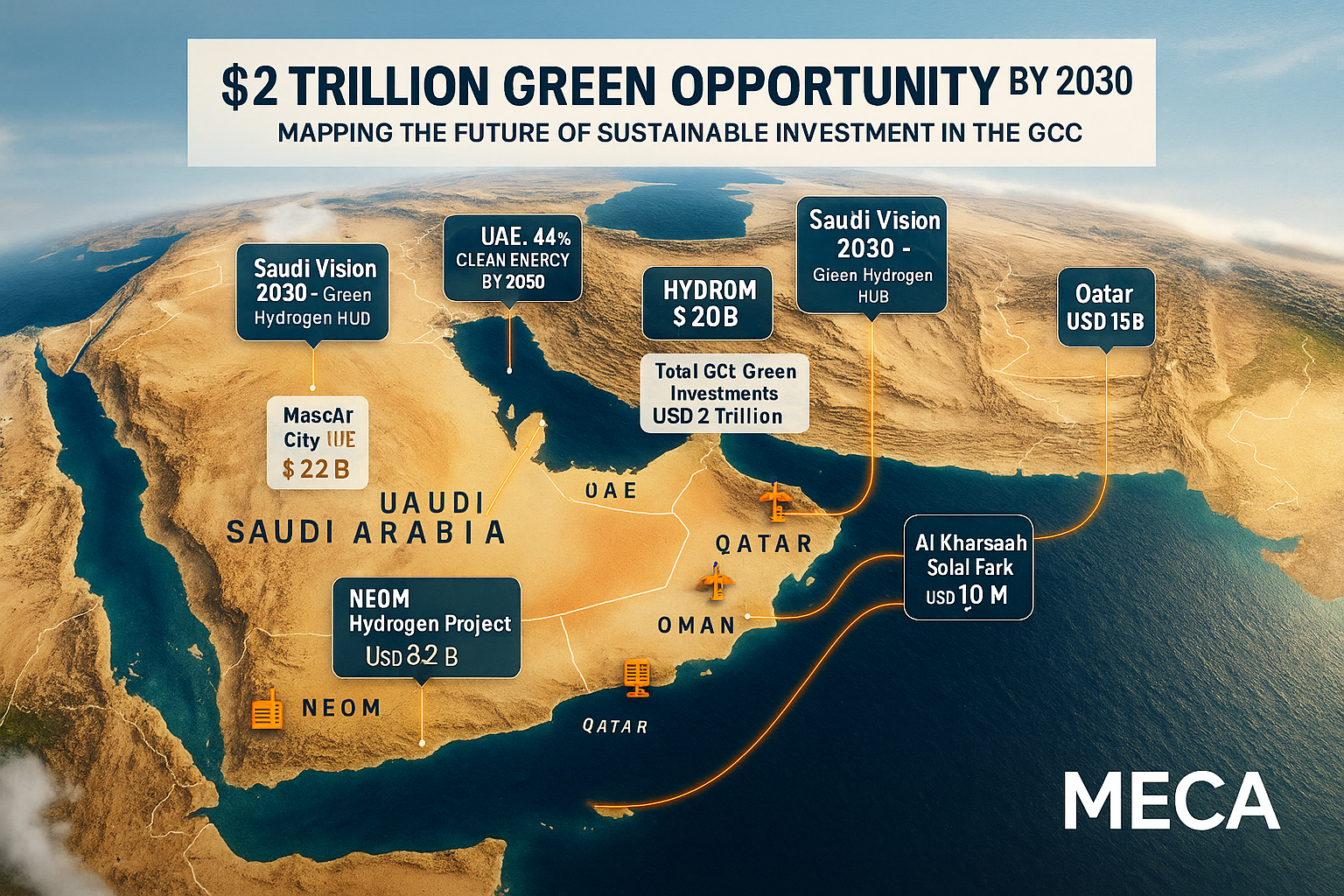
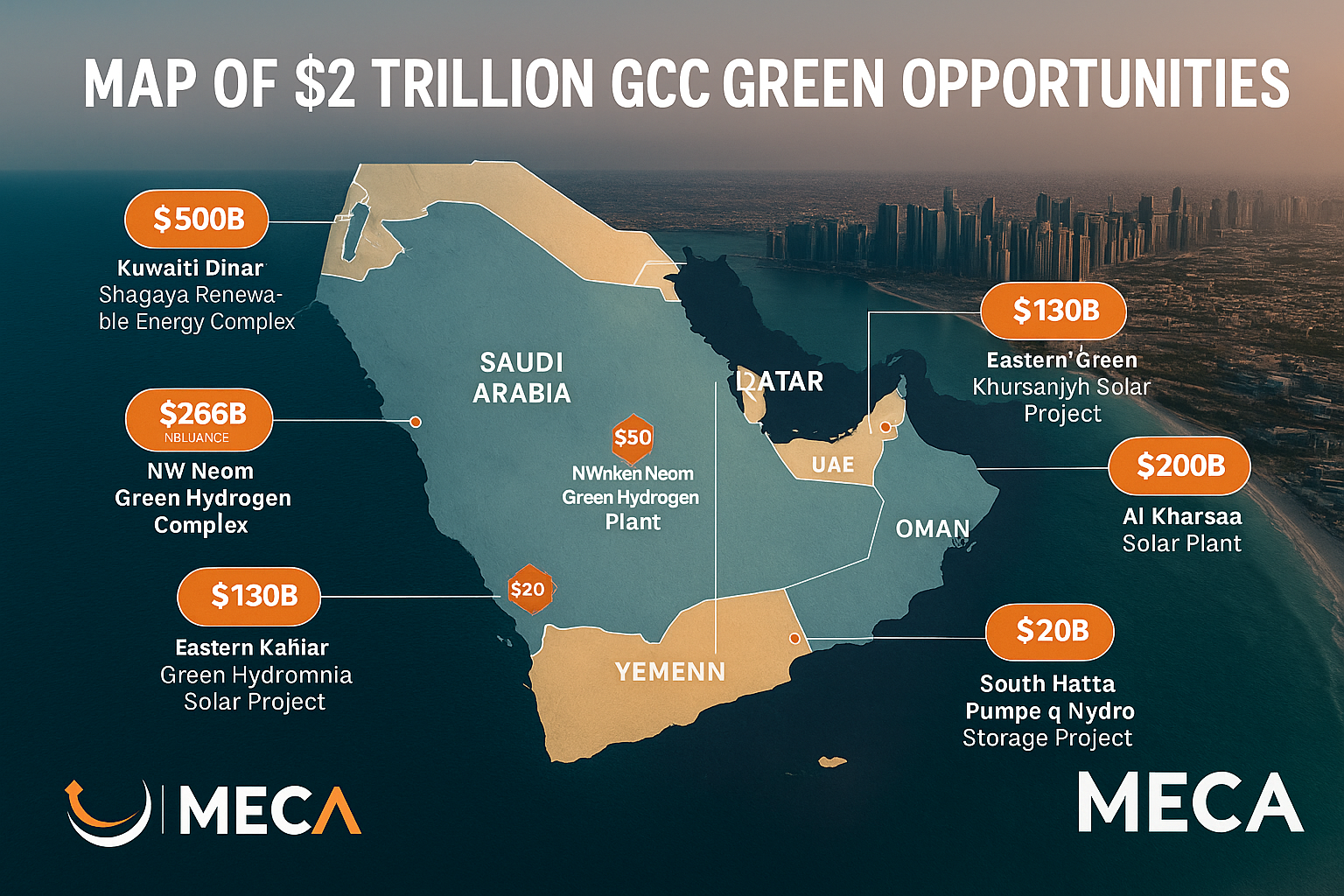
The Gulf is shifting from hydrocarbons to high-growth green value chains at speed. Leading analysis indicates that, with the right policies and bankable structures, green investments across six priority sectors could unlock up to US$2 trillion in cumulative GDP impact by 2030, and create more than one million jobs.  More recent regional commentary underscores the trend: since 2020, over half of all large-scale global FDI has flowed into green sectors, and GCC countries are capturing an increasing share.
What’s driving the surge?
•Policy & finance tailwinds: The UAE Consensus at COP28 mobilized tens of billions in climate finance commitments and set clearer targets on tripling renewables and doubling efficiency. Flagship vehicles such as ALTÉRRA and Brookfield’s Catalytic Transition Fund are channeling capital toward emerging markets, a powerful signal to project developers and lenders.
•Anchor projects: Saudi Arabia’s latest multi-GW solar and wind pipeline, alongside the US$8.4B NEOM green hydrogen financial close, are de-risking perceptions and setting reference prices and structures for the region.
•Hydrogen scale-up: Oman’s Hydrom is orchestrating concessions to deliver ~1 Mtpa green hydrogen by 2030 and far more by 2050, while Duqm is positioning as a major export hub a template for industrial policy that links upstream renewables to downstream fuels and chemicals.
Beyond megawatts: the wider green economy
The US$2T opportunity is not only about utility-scale solar. It spans green buildings, storage, grids and digitalization, EV/charging, low-carbon fuels, and industrial efficiency. In IEA scenarios, Middle East clean-energy investment more than triples by 2030, shifting the investment mix decisively toward clean technologies.
Key bankability questions global investors ask
1.Revenue certainty (PPA tenor, indexation, curtailment protections)
2.FX/commodity exposure (hedging, local content, capex localization)
3.Legal enforceability (offtaker risk, step-in rights, international arbitration)
4.Export pathways (EU/Asia demand for green ammonia/hydrogen and certification regimes)
Where MECA (and GATE) add real value
MECA (headquartered in the UAE & Oman) and its European counterpart GATE (Luxembourg) are built to bridge global capital with GCC green projects:
•B2B Matchmaking & FDI Origination: Curated introductions across developers, EPCs, OEMs, funds, and offtakers in solar, wind, hydrogen, and storage.
•Bankable Contracts & Risk Structuring: Support on PPAs, EPC/EPCM, O&M, offtake MOUs, and cross-border arbitration to reduce legal and counterparty risk.
•European Capital Access via Luxembourg: SPV structuring, green bonds/sustainability-linked instruments, and outreach to institutional LPs seeking scalable GCC exposure.
•Market Intelligence & Route-to-Market: Practical insights on certification, standards, and export logistics for hydrogen/ammonia into the EU and Asia.
A practical entry sequence for investors
1.Opportunity screen: Prioritize 3–5 verticals (e.g., hydrogen/ammonia, utility-scale solar, storage, green buildings).
2.Pre-feasibility with sensitivities: Capex/Opex, FX, and carbon-price cases to stress-test IRR.
3.Commercial & legal structuring: Bankable PPAs, robust offtake, and arbitration-ready contracts; SPV in Luxembourg or DIFC as needed.
4.ESG and disclosure: Align with investor-grade reporting frameworks to unlock cheaper capital.
5.Export strategy: Map end-markets and certification to secure premium pricing.
Bottom line: The GCC’s green transition has moved from narrative to investable pipelines, backed by policy, flagship projects, and scaled finance. If you are assessing entry or expansion, MECA/GATE provide the connective tissue:
partners, contracts, capital, and markets.